Current research

My current work focuses on extending swarm robotics beyond fixed, reactive controllers: making swarms move faster and more efficiently under physical constraints, perceive richer environments, adapt online, and use language as part of multi-agent control.

Fast and energy-efficient swarm motion

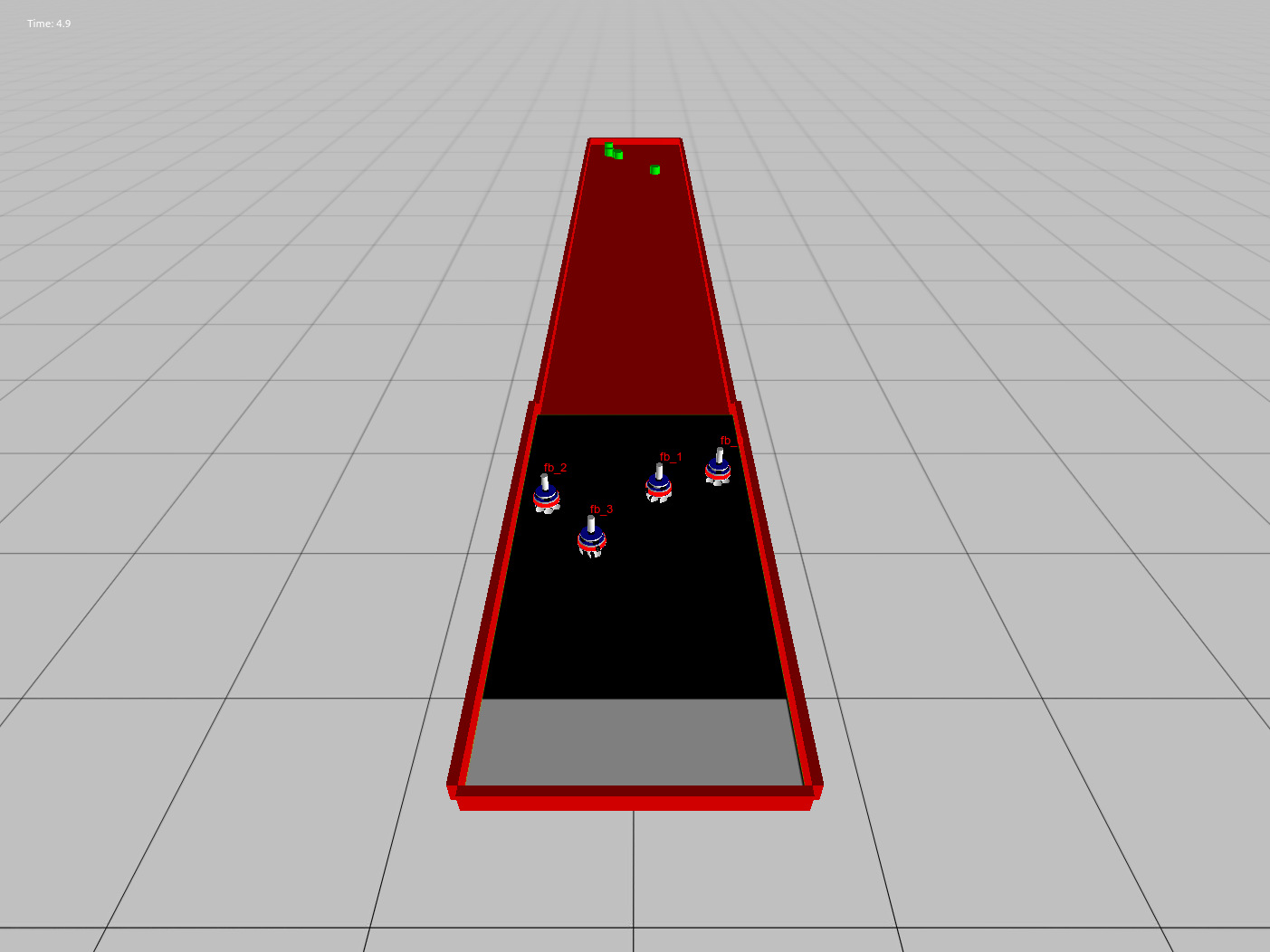
Swarm gradient-following through geometrically constrained paths of increasing sinuosity.

I am studying how decentralized swarms can move rapidly without losing cohesion when geometry, swarm size, and energy constraints matter. Recent work benchmarks gradient-following in constrained paths and shows where large swarms or sharp turns become limiting; in parallel, I study how local learning can produce energy-saving formation reconfiguration from very limited sensing.

People & collaborators
Related publications

Conversational agents for collective perception

Conversational agents exchanging information during collective environmental perception.

I am studying how communication in robot swarms can move beyond simple signals. By allowing agents to exchange and interpret richer, language-like information, the goal is to support collective environmental perception and social learning in situations where the relevant representation is not fixed in advance.

People & collaborators
Related publications

Hebbian learning for heterogeneous swarm control

Hebbian learning produces online collective behaviour switching as the swarm discovers and follows the gradient.

I use Hebbian learning as a local adaptation mechanism for swarm control. A single learning rule can be shared by all robots while different behaviours emerge online across the swarm, avoiding a separate controller parameterization for every agent and providing a scalable route to learned heterogeneity.

People & collaborators
Related publications

Natural-language control of multi-agent systems

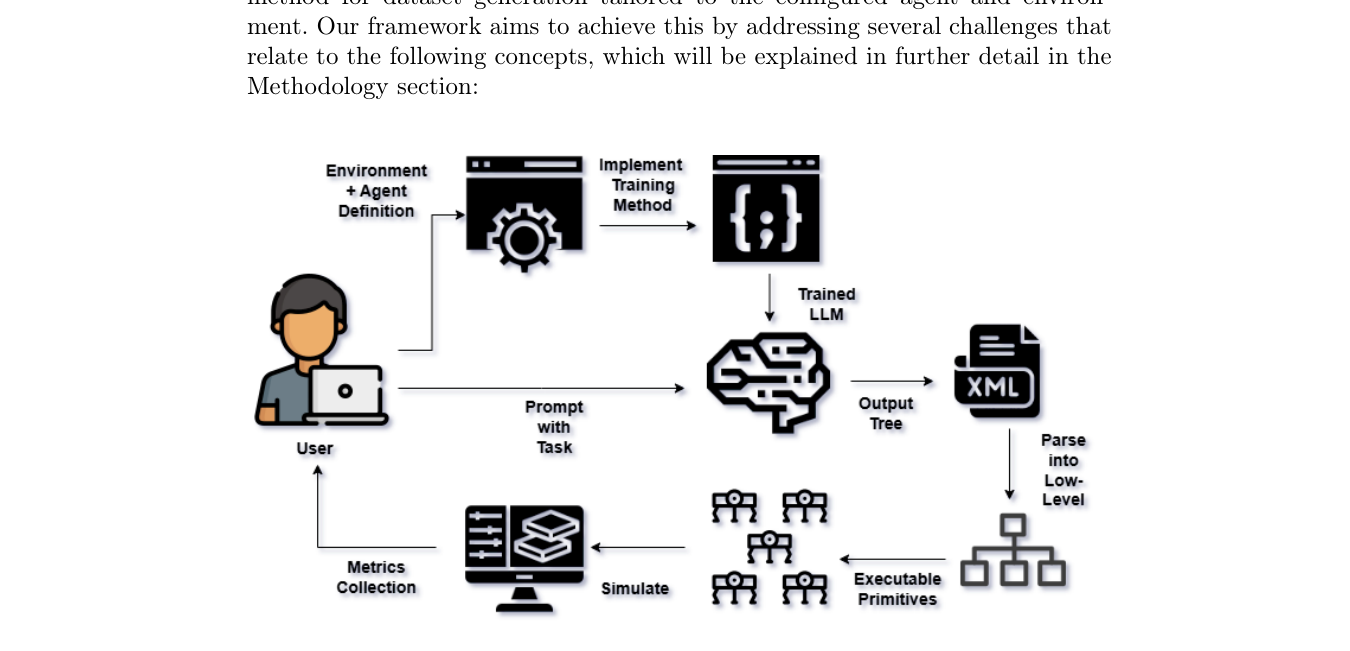
Overview of the MinionsLLM framework connecting natural-language task specification, formal controller generation, simulation feedback, and model training.
MinionsLLM framework for natural-language design and control of multi-agent systems.

MinionsLLM combines large language models with behaviour trees and formal grammars to translate natural-language task descriptions into structured multi-agent controllers. The aim is to keep language-based control flexible while preserving syntactic validity, explicit behavioural primitives, and a controller representation that can be inspected and adapted.

People & collaborators
Related publications

Swarm robotics in real-world environments

A second part of my work takes decentralized swarm control onto physical aerial robots, where localization, communication, sensing, vehicle dynamics, and deployment procedures cannot be abstracted away.

Fixed-wing swarm synchronization

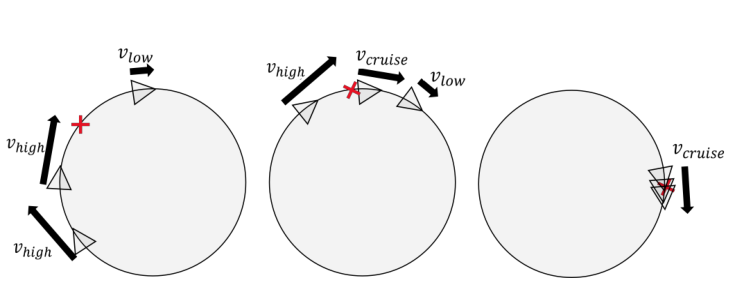
Three fixed-wing UAVs synchronizing their positions while flying around a circular loitering path.
Distributed loitering synchronization for sequentially launched fixed-wing UAVs.

Fixed-wing UAVs cannot simply wait in place while the rest of a swarm is launched. I studied distributed loitering synchronization: algorithms that align continuously moving aircraft around a loitering circle so that a coordinated mission can start from suitable initial conditions. The work includes a firefly-inspired method that achieves comparable synchronization with much less communication.

People & collaborators
Related publications

Fast UAV swarming without external infrastructure

Nine-UAV self-organized flocking for desert exploration without explicit communication.

With Martin Saska's group, I worked on decentralized UAV swarms that remain coordinated in GNSS-denied, feature-poor environments and under unreliable or absent communication. The work combines onboard mutual perception, relative state estimation, and flocking control, and was validated in demanding real-world experiments, including fast collective flight near the limits of the platforms.

People & collaborators
Related publications

Onboard source seeking with nano-UAV swarms

Crazyflie swarm seeking a moving light source while avoiding an obstacle.

I developed fully onboard swarm control for nano-UAVs to follow dynamic scalar-field gradients in GNSS-denied indoor environments. The robots use local interactions and individual scalar sensing, with obstacle avoidance added without relying on external infrastructure.

People & collaborators
Related publications

Automatic design and learning in robot collectives

A recurring problem in collective robotics is the micro–macro problem: how to design individual-level rules that reliably generate a desired group-level behaviour. I study this as an automatic-design and learning problem, with emphasis on controllers that remain scalable, transferable, and interpretable.

Learning on evolvable and modular robots

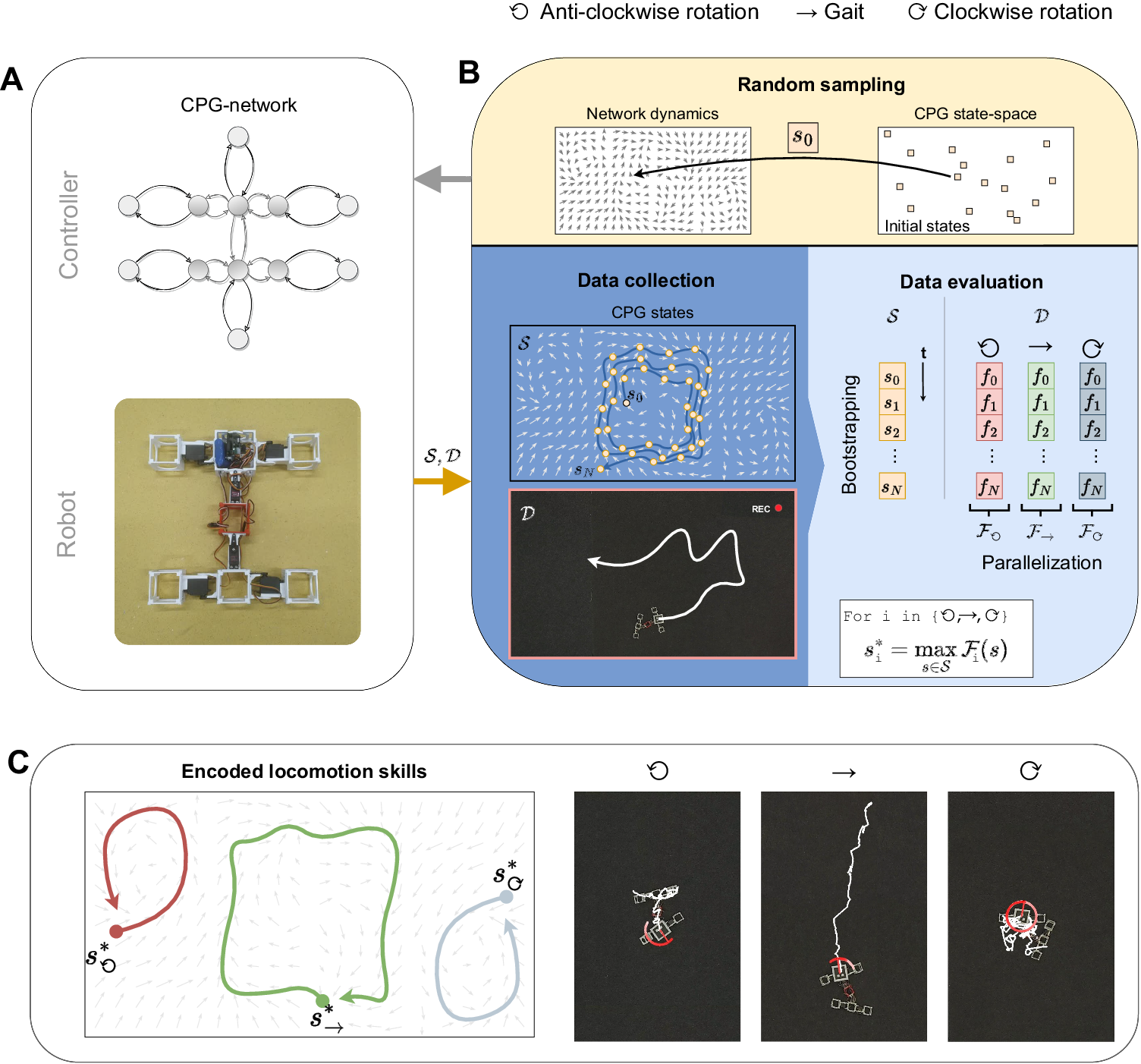
Model-free parallel skill learning framework and physical modular robot experiments.
Model-free learning of multiple locomotion skills on modular robots.

I extended automatic design beyond fixed robot bodies by studying controller learning when morphology itself varies. This includes the reality gap in systems where both morphology and control evolve, comparisons of learning methods across previously unseen morphologies, and a model-free method that learns several locomotion skills directly on physical modular robots in only a small number of trials.

People & collaborators
Related publications

Evolution of task specialization

Antlike robots might help explain origins of cooperation — Science/AAAS coverage of the task-specialization work.

I use evolutionary swarm robotics both to engineer collective behaviour and to study how it can arise. In our PLOS Computational Biology work, identical robots evolved division of labour through task partitioning; specialization emerged because environmental structure reduced switching costs, without specialization itself being directly rewarded.

People & collaborators
Related publications

Automatic design of interpretable swarm controllers

GESwarm foraging environment used to evolve interpretable swarm controllers.
GESwarm foraging setup for automatic synthesis of readable swarm controllers.

With GESwarm, I used grammatical evolution to synthesize collective behaviours as readable condition-action programs rather than opaque neural controllers. Later work with AutoMoDe-Pomodoro combined evolutionary search with modular behavioural representations, keeping automatic design structured while opening it to a broader range of evolutionary methods.

People & collaborators
Related publications

Decentralized collective decision-making

I have studied how a robot swarm can reach a collective choice using only local interactions and no central coordinator: how consensus emerges, how the swarm trades speed against accuracy, how it adapts when the environment changes, and how minority opinions affect the outcome.

Self-organized collective decision-making

Can ants inspire robots? — self-organized decision making with the k-unanimity mechanism.

I developed and analysed mechanisms in which differences in action duration can bias local opinion dynamics toward the better option, even when robots never measure that quality explicitly. This line includes majority rule with differential latency and the k-unanimity rule, tested analytically, in simulation, and on physical robot swarms.

People & collaborators
Related publications

Speed-accuracy trade-offs in collective decisions

Self-Organized Collective Decisions in a Robot Swarm — 100-Kilobot experiments on speed versus accuracy.

With 100 Kilobots, I studied how a swarm can make fast and accurate binary choices with minimal individual capabilities. The experiments and models show how interaction neighbourhood size controls the speed-accuracy trade-off, providing a way to tune collective decision performance.

People & collaborators
Related publications

Collective decisions with stubborn minorities

Physical Kilobot arena used to test collective decision-making in the presence of zealots.
Physical Kilobot arena used to test robustness to zealots.

I studied how zealots—agents that never change opinion—alter best-of-n decisions, and when informed agents can counteract them. Simulations, mathematical models, and Kilobot experiments show that consensus can still favour the better option provided adverse zealots are not too numerous, and that informed individuals extend this robust regime.

People & collaborators
Related publications

Informed individuals in self-organized swarms

I have repeatedly used a simple idea across different collective behaviours: give extra information to only a small subset of agents, but let them interact through the same local rules as everyone else. Their influence then appears at the group level without introducing a central controller.

Gradient-following with informed robots

Real nano-drone gradient-following experiments with sensory and non-sensory agents.

In gradient-driven flocking, only part of the swarm needs access to the environmental signal. Those informed robots bias the motion through ordinary local interactions, allowing the whole group to move toward higher-value regions while most robots remain non-sensory.

People & collaborators
Related publications

Guiding self-organized aggregation

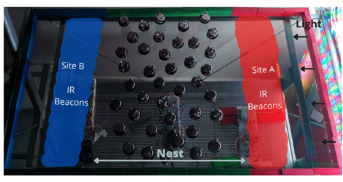
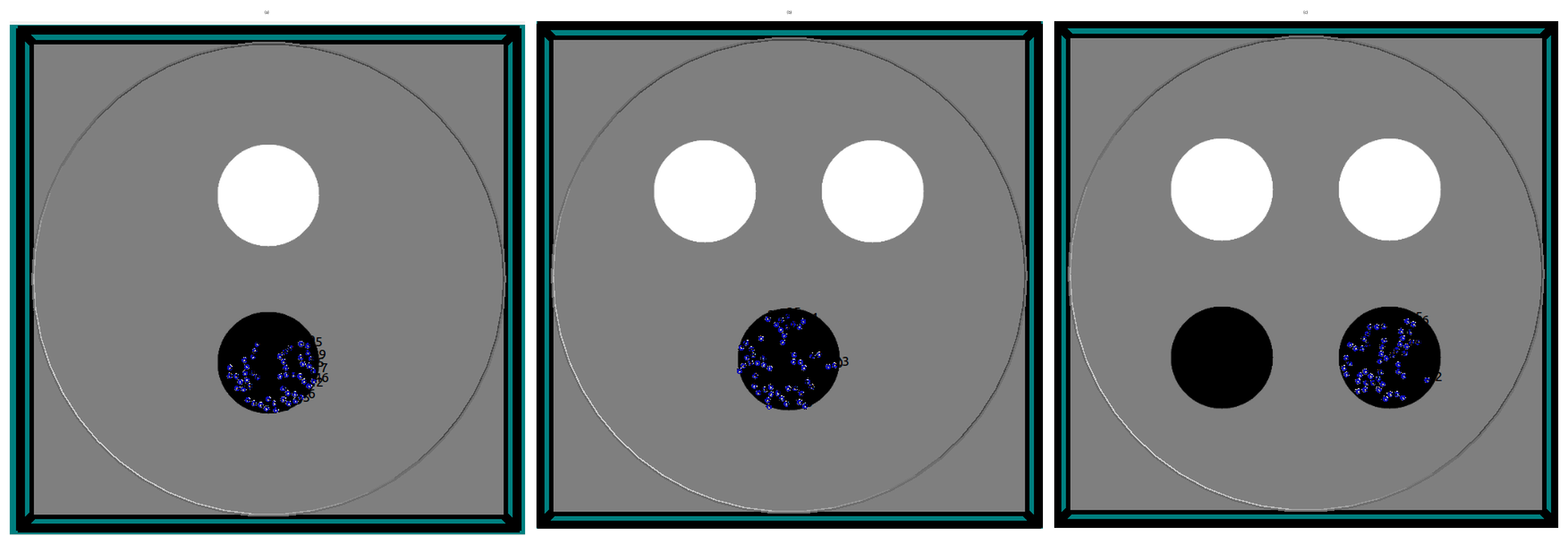
Three aggregation arenas with target and non-target sites from the informed-robot aggregation study.
Aggregation scenarios with two, three, and four candidate sites.

In self-organized aggregation, a small proportion of informed robots can bias an otherwise symmetric choice toward a predefined site. The informed robots are not explicit leaders: they follow the same aggregation dynamics as the rest of the swarm, differing only in which sites they are willing to stop on.

People & collaborators
Related publications

Adaptation through stubborn minorities

Kilobot arena used in experiments on minority influence in collective decision-making.
Kilobot collective decision-making experiment with minority influence.

Stubborn agents are not always detrimental. In dynamic best-of-n problems, a small persistent minority can preserve alternatives and help the swarm leave an outdated consensus after option qualities change. The same mechanism exposes a trade-off: too many stubborn agents reduce decision performance.

People & collaborators
Related publications

Steering collective motion with informed robots

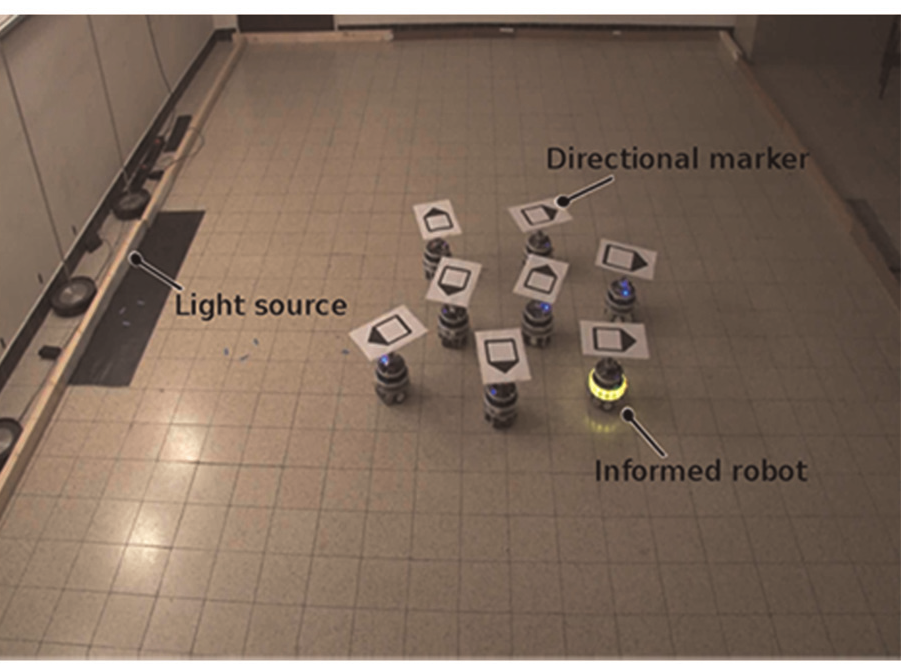
Experimental arena used in collective-motion experiments with informed robots embedded in a flock.
Real-robot collective motion with informed agents steering from within the swarm.

In flocking, a minority of robots with directional information can steer the group while the rest use only local interaction rules. This line started from real-robot studies of self-organized flocking and now extends to collective exploration, where leader-like roles can emerge from local sensing rather than being assigned globally.

People & collaborators
Related publications

Foundations of collective motion

My earlier work on collective motion sits at the interface between swarm robotics and statistical physics. I studied how coherent motion can arise from local position-based interactions, what minimal information robots need for flocking, and how long-range correlations emerge in moving groups.

Elasticity-driven collective motion

Video abstract for the active-solids and active-crystals model, explaining the elasticity-based mechanism for collective motion.

I introduced a model of self-propelled agents coupled by spring-like positional interactions but no explicit alignment rule. Below a critical noise level, the group self-organizes into translation or rotation. The mechanism transfers self-propulsion energy toward low-energy elastic modes, providing an alternative route to collective motion based on position interactions alone.

People & collaborators
Related publications

Scale-free correlations in collective motion

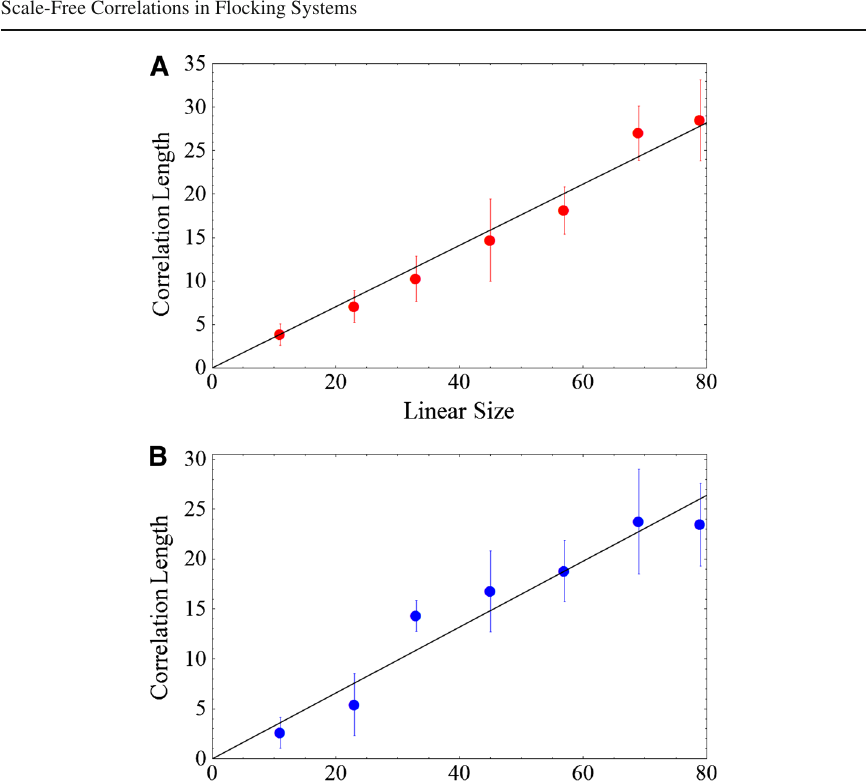
Correlation lengths of velocity and speed fluctuations plotted against linear group size, showing approximately linear scaling.
Correlation lengths grow with group size, producing scale-free velocity and speed fluctuations.

Using the same position-based framework, I studied fluctuations in moving groups and found that velocity and speed correlation lengths grow with the linear size of the group. The resulting correlations are scale-free without requiring the system to be tuned to a critical point, suggesting a direct connection between the interaction structure and large-scale collective dynamics.

People & collaborators
Related publications

Self-organized flocking in robot swarms

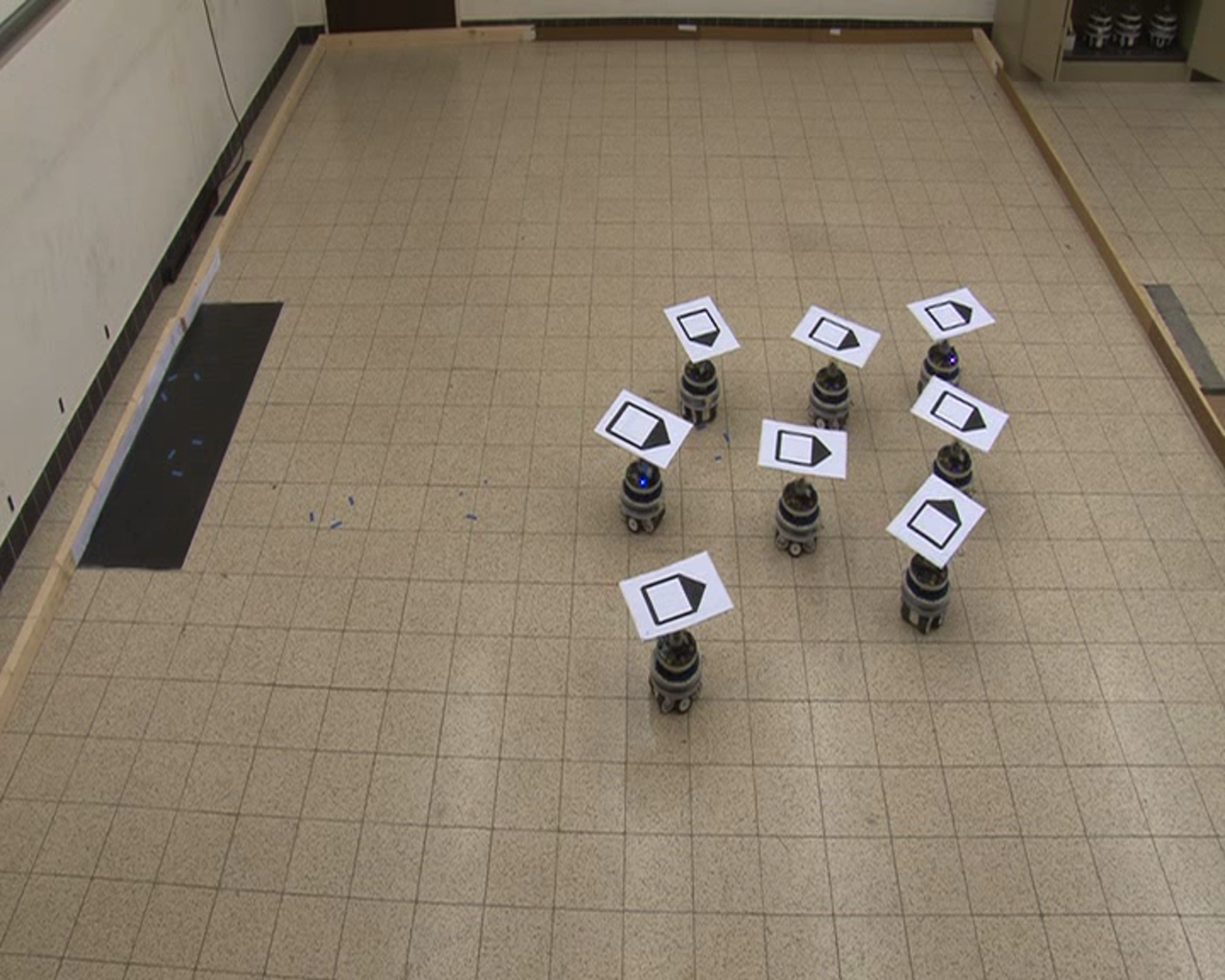
Overhead view of eight real foot-bots flocking with no informed robots and no explicit alignment control.

My early swarm-robotics work asked what information robots actually need to flock. I showed experimentally that appropriate motion control can produce coherent motion without explicit heading alignment, and studied how directional information and adaptive communication can be introduced while preserving decentralized control.

People & collaborators
Related publications